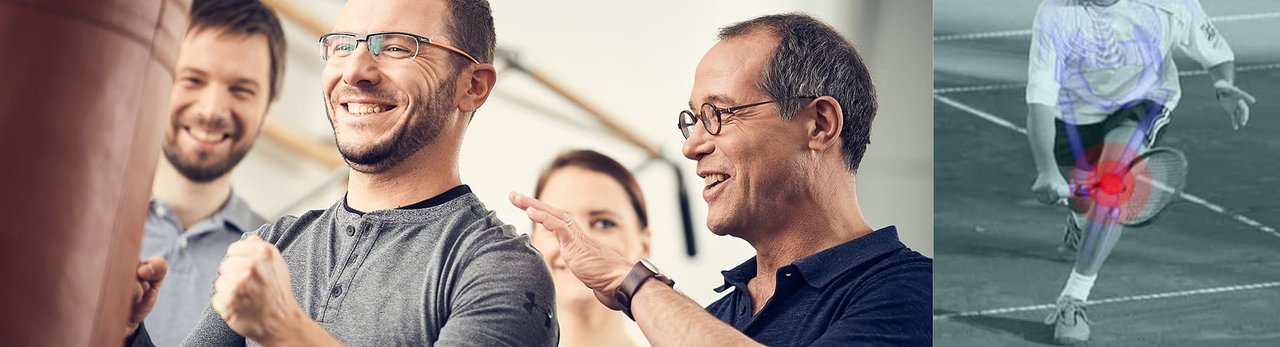
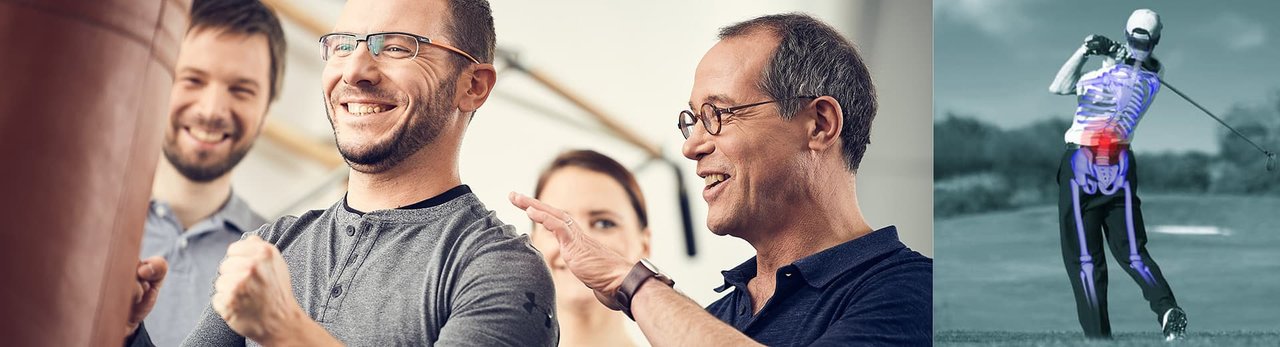
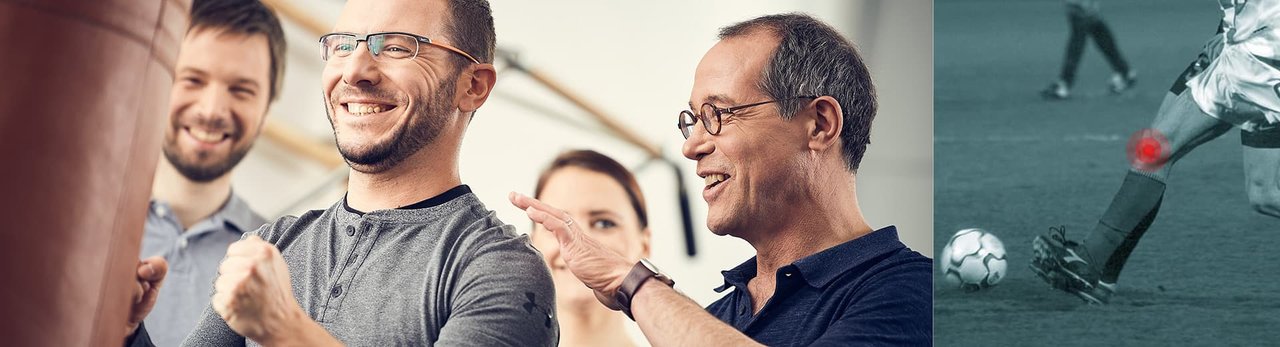
Can I return to sport and physical activity with a new joint?
A question that is not easy to answer, but at the same time is easy to understand. Sports and physical activity are of great importance to many people, as they promote well-being and have positive psychological effects, as well as physical benefits.
The extent to which a hip, knee, or ankle joint replacement can be subjected to intensive, physically strenuous activities at work or during leisure time (e.g. sport) and the risk of damaging the prosthesis is the subject of controversial medical debate.
Development of Joint Replacement Surgery
With the continued advancement of joint replacement surgery and its adaptation to a younger population, the expected goals and outcomes of these procedures are no longer limited to pain relief and improved quality of life. Patients' expectations have risen to include a more active lifestyle and a return to their previous level of sports performance.
Joint Replacements and the Working Population
The working population constitutes a significant portion of joint replacement patients. According to the National Registry of England and Wales, 40% of hip replacement and 32% of knee replacement patients were under 65 years old at the time of surgery. The return-to-work rate for patients with joint replacements (hip or knee) was 91%, occurring on average 6.4 weeks after hip replacement surgery and 7.7 weeks after knee replacement surgery.
The rate of return to sports varied between 54% and 98%, according to a systematic review involving 10,758 patients with an average age of 61.7 years.
Recommendations for Sporting Activities
Low-impact activities, such as golf, brisk walking, and road cycling, as well as some moderate-impact activities like skiing and weightlifting, were recommended by doctors from the Hip Society in Wales. In contrast, high-impact activities like jogging, contact sports, and snowboarding were generally discouraged. The reason skiing is considered acceptable while snowboarding is not remains unclear, possibly due to the age demographics of the patients.
In general, 10,000 steps per day are recommended to achieve and maintain the health benefits of physical activity.
Postoperative Strain and Risks
There is limited evidence to suggest that postoperative activities (work or leisure) increase the risk of knee revision and may even have a protective effect. While "heavy work," agricultural activities, and – in women – healthcare work have been associated with a higher risk of prosthesis failure, there is insufficient high-quality evidence that physically demanding jobs or intense sports significantly increase this risk.
Sports with a New Hip
Whether patients with a hip replacement can run again depends primarily on whether they ran or tried to run before the surgery.
Many patients can continue running after hip replacement surgery. Previous concerns that implants would wear out due to sports activity have not been confirmed in the literature. Recent studies show no increased failure rates among physically active patients.
Additionally, modern implant designs and materials (e.g., robotic-assisted and anterior hip replacements) have improved stability and durability, leading to better sports performance.
Some studies report that up to 100% of patients return to sports after hip replacement surgery, while others report rates as low as 40%. Therefore, a careful analysis of patients' lifestyle and activity goals is necessary.
High-intensity activities with a high risk of injury (e.g., mixed martial arts) should be avoided. However, most patients can jog, swim, occasionally play football, play tennis, or ski without prematurely wearing out their prosthesis.
Typically, patients return to sports 4–6 months after surgery.
Sports with a New Knee
The European Knee Association, a division of the European Society of Sports Traumatology, Knee Surgery, and Arthroscopy, has issued recommendations for 47 sports after knee replacement surgery. These are divided into four periods:
- Up to 6 weeks post-surgery: Walking, stair climbing, swimming, aqua fitness, and stationary cycling.
- 6–12 weeks post-surgery: Additionally, cycling on flat terrain and yoga.
- 3–6 months post-surgery: Doubles tennis, golf, fitness/weightlifting, aerobics, hiking, Nordic walking, and sailing.
- From 6 months post-surgery: An increasing variety of activities, although squash remains discouraged.
The recommendations demonstrate that the intensity and number of approved sports activities gradually increase as the recovery period progresses.
Of ultramarathon runners who took part in at least one of the five Ultratrail du Mont Blanc races in France between 2015 and 2017 (between 55 and 300 km), one of the four runners who ran with a knee replacement had to end his race. This dropout rate of 25% (admittedly from a very small sample) compares favorably with the overall dropout rate of 19.6% among the 3,171 runners surveyed who took part in a race.
None of the four runners with a knee replacement reported negative knee-related symptoms before, during, or after the race, while some of the runners who had a hip replacement reported such symptoms.
It is also possible for average runners to run again after a knee replacement. Out of a total of 4,074 patients who had a knee replacement, 23 out of a total of 131 runners started running again after the operation.
Not all runners return to running after a knee replacement. Whether they were physically unable to run after their knee replacement and/or whether they were afraid of damaging or wearing out their new knee is unclear.
Whether running wears out the artificial knee joint cannot be said with certainty. Although experts believe that high-impact activities can wear out the replaced joint more quickly, there is no conclusive scientific evidence to support this. There are hardly any studies that have investigated the effects of physical activity on prosthesis wear.
Shoulder prosthetics
As more and more people are having shoulder replacements, it is becoming increasingly important for them to be able to return to sports afterwards.
The return to sport depends crucially on the type of shoulder replacement.
On the one hand, there is the anatomical total shoulder arthroplasty, in which both the ball (humeral head) and the socket (glenoid) of the shoulder joint are replaced with artificial components. This type of replacement is usually performed in patients with severe osteoarthritis but an intact rotator cuff. Approximately 77-90% of patients with such a prosthesis successfully return to some form of sport within 6 to 9 months.
On the other hand, there is the reverse or inverse shoulder arthroplasty, in which the ball component is placed on the shoulder blade (glenoid) and the socket is attached to the upper arm bone (humerus). This procedure is used in patients with severe osteoarthritis in conjunction with large, irreparable tears in the rotator cuff. Around 65-75% of patients with such a prosthesis can resume sport after 6 to 9 months - however, with the restriction that overhead movements are considerably more difficult to perform.
As with hip and knee prostheses, the level of activity before the operation has a major influence on recovery. Age also plays an important role: patients over the age of 65 must expect a longer recovery phase.
Low-impact sports such as golf, swimming, and cycling are generally safe and effective ways to remain active after surgery. However, sports that require dynamic movements, overhead movements, or heavy lifting—such as tennis, basketball, and weightlifting—are more challenging. They put a lot of strain on the shoulder joint and increase the risk of complications, which is why they are less suitable for patients who do not want to jeopardize their new shoulder.
Taking these factors into account helps patients set realistic goals, can make the recovery process smoother, and allows them to maintain an active and healthy lifestyle.
Ankle joint prosthetics
Persistent pain in the ankle joint is predominantly caused by trauma and ultimately results in osteoarthritis. Only in some cases is this pain due to purely arthrotic changes.
Once conservative treatment measures have been exhausted, two options are available: the use of an artificial ankle joint or surgical fusion or arthrodesis. Although arthrodesis of the ankle was considered the gold standard in the past, advances in implant design, surgical technique and functional outcomes have made total ankle replacement a compelling alternative. In the last 20 years in particular, total ankle replacement has undergone enormous innovation and the field of research into this procedure continues to grow. Nevertheless, it must be noted that the overall number of upper ankle replacement operations in Germany is probably around 1,500 to 2,000 compared to hip and knee replacement operations.
Patients who underwent primary ankle replacement surgery showed generally improved ankle function with acceptable complication rates and durability rates of 66-90% over a follow-up period of at least 10 years. For patients who experienced implant failure, the average time to failure ranged from 4.6 to 13.8 years.
Return to sport and physical work
After an appropriate healing and rest phase, most patients also regain their ability to play sports: walking uphill and downhill, climbing stairs, walking and running on uneven surfaces as well as swimming, hiking, cycling, and skiing are no longer a problem for the majority of prosthesis wearers in the medium term. Participation in strenuous sports such as tennis, football, and running was consistently restricted after the operation.
Take-Home Message
- Patients' expectations for total joint replacement extend beyond pain relief and quality of life, including sports and physical activities.
- Preoperative counseling is essential to set realistic expectations and avoid disappointment.
- Wear rates depend on the level of activity and joint strain.
- Doctors are increasingly recommending low- and moderate-impact activities, while high-impact sports remain controversial.
- The lack of evidence that running wears out or damages a knee or hip prosthesis should not be taken as proof that running with a knee or hip prosthesis is entirely safe.
- However, most experts agree that patients can return to sports again six months after surgery.
- In the ankle area, there is a lack of larger, long-term follow-up case numbers and prospective, randomized studies to achieve a significance comparable to that of hip and knee joints. It is therefore difficult to make precise predictions about sporting activity after ankle replacement surgery, so caution is advised.
References
- Meek, R. M., Treacy, R., Manktelow, A., Timperley, J. A., & Haddad, F. S. (2020). Sport after total hip Arthroplasty: Undoubted progress but still some unknowns. The Bone & Joint Journal, 102-B(6), 661–663. https://doi.org/10.1302/0301-620x.102b6.bjj-2020-0208 online.boneandjoint.org.uk/doi/epub/10.1302/0301-620X.102B6.BJJ-2020-0208
- Hoorntje, A., Janssen, K.Y., Bolder, S.B.T. et al. The Effect of Total Hip Arthroplasty on Sports and Work Participation: A Systematic Review and Meta-Analysis. Sports Med 48, 1695–1726 (2018). doi.org/10.1007/s40279-018-0924-2
- Huch K, Muller KAC, Sturmer T, Brenner H, Puhl W, Gu¨nther KP. Sports activities 5 years after total knee or hip arthroplasty: the Ulm Osteoarthritis Study. Ann Rheum Dis. 2005;64:1715–20.
- Schmidutz F, Grote S, Pietschmann M, Weber P, Mazoochian F, Fottner A, et al. Sports activity after short-stem hip arthroplasty. Am J Sports Med. 2012;40:425–32.
Zaballa E, Harris EC, Cooper C, Linaker CH, Walker-Bone K (2022) Risk of revision arthroplasty surgery after exposure to physically demanding occupational or leisure activities: A systematic review. Published: February 28, 2022. https://doi.org/10.1371/journal.pone.0264487
Fawaz WS, Masri BA. (2020) Allowed activities after primary Total knee arthroplasty and Total hip arthroplasty. Orthop Clin North Am. 2020;51(4):441–52. https://doi.org/10.1016/j.ocl.2020.06.002.
David Slattery, orthopädischer Chirurg, Melbourne. https://davidslattery.com/run-after-hip-replacement/
Thaler, M., Khosravi, I., Putzer, D., et al. (2021) Twenty-one sports activities are recommended by the European Knee Associates (EKA) six months after total knee arthroplasty. Knee Surg Sports Traumatol Arthrosc 29, 694–709 (2021). https://doi.org/10.1007/s00167-020-06400-y
Rochoy M, Six J, Favre J, Lagrange N, Lefebvre J-M, Rollier J-C, Girard J (2020) Does hip or knee joint replacement decrease chances to complete an ultra-trail race? Study in participants at the Ultra-Trail du Mont Blanc. Orthopaedics & Traumatology: Surgery & Research, Volume 106, Issue 8, December 2020, Pages 1539-1544
Marco J Konings, Henri De Vroey, Ive Weygers, Kurt Claeys - Effect of knee arthroplasty on sports participation and activity levels: a systematic review and meta-analysis: BMJ Open Sport & Exercise Medicine 2020;6:e000729
Liu JN, et al. “Return to Sports After Shoulder Arthroplasty: A Systematic Review and Meta-Analysis.” Knee Surg Sports Traumatol Arthrosc. 2017
Davey, et al. “Return to Sport Following Reverse Shoulder Arthroplasty: A Systematic Review.” Journal of Shoulder and Elbow Surgery, 2021
Aim F, Werthel J-D, Deranlot J, Vigan M, Nourissat G(2018) Return to Sport After Shoulder Arthroplasty in Recreational Athletes: A Systematic Review and Meta-analysis. Am J Sports Med. 2018 Apr;46(5):1251-1257. Doi: 10.1177/0363546517714449. Epub 2017 Jul 18. PMID: 28719752
Shaffrey I, Henry J, Demetracopoulos C(2023) An evaluation of the total ankle replacement in the modern era: a narrative review. Ann Transl Med. 2023 Jul 12;12(4):71. doi: 10.21037/atm-23-1569. PMCID: PMC11304414 PMID: 39118953.
Lee MS, Mathson L, Andrews C, et al. (2024) Long-term Outcomes After Total Ankle Arthroplasty: A Systematic Review. Foot & Ankle Orthopaedics. 2024;9(4). Doi: 10.1177/24730114241294073.
Rehart S, Schubert L, Valo M (2022) Endoprothetik des OSG – ein Update. OUP 2022; 11: 18–22. Doi: 10.53180/oup.2022.0018-0022.