

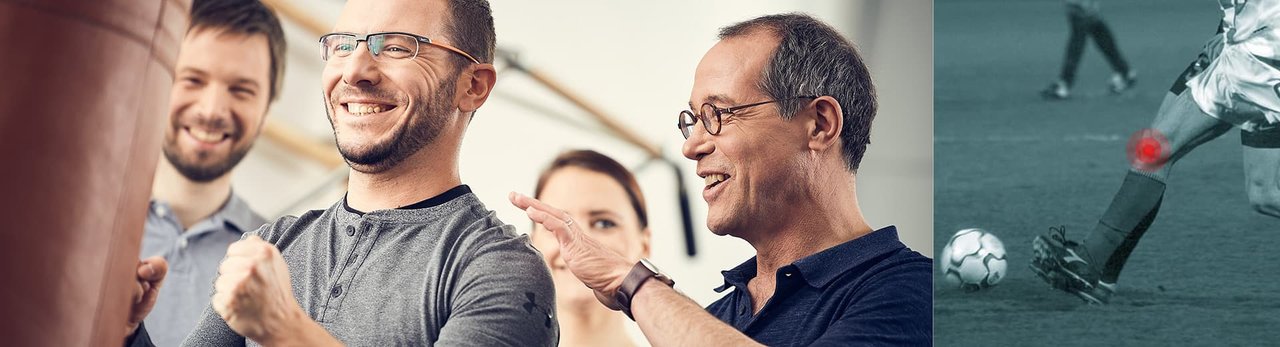
Injury prevention in sport - principles instead of blanket solutions
Injured again and again? Perhaps it's not due to chance, but to training. If you understand how strain works, how movement is controlled, and what protects joints, you can specifically prevent injuries in sport. Instead of relying on general tips, it is worth looking at functional relationships and sport-specific principles. This article shows what matters.
Injury Prevention in Sports – Principles Instead of Blanket Solutions
(This article was published on 26.05.2025 at Orthinform - Patient information: https://orthinform.de/patienteninformationen/verletzungspraevention-im-sport-prinzipien-statt-pauschalloesungen/)
Sports are healthy – no doubt about it. Physical activity strengthens the cardiovascular system, has a positive effect on the immune system, and enhances both physical and mental well-being. However, as sports become increasingly popular, the number of injuries also increases. Every year, millions of people get injured during training or competitions – often unnecessarily. Many of these injuries can be prevented through targeted prevention. The key lies in a better understanding of (joint) load, movement control, and sport-specific risk factors. This article demonstrates how focusing on principles rather than generic solutions can lead to greater safety in sports.
Prevention Instead of Cure – Is It Worth It?
Sports injuries can never be completely avoided. Nevertheless, their frequency and severity can be significantly reduced through targeted measures. Popular ball sports are especially affected due to their high intensity and frequent physical contact.
General advice like “warm up well” or “play fair” is important, but often not enough. More effective are specific exercises that improve joint functionality, tailored to the demands of each sport. The way training is structured also plays a crucial role. For example, in running, not only does technique matter. A gradual increase in load is equally important so joints, bones, and tendons can adapt. If this adaptation process is ignored, the risk of overuse injuries increases significantly. In contact sports, it's also essential to anticipate opponents’ movements early to avoid potentially dangerous collisions.
Rather than relying on generic advice, it's worthwhile to apply sport-specific principles. This approach helps prevent not only acute overload but also recurrent injuries, such as repeated dislocations.
Recognizing Risk Factors – Preventing Injuries with Precision
To prevent injuries effectively, potential risks must be identified early. Joints are especially vulnerable, particularly when mobility is limited, pain arises under load, or muscles fatigue quicker than expected. Weakness in specific areas may also be a warning sign. The body often compensates for such deficits with altered movement patterns: a shoulder blade may become unstable during arm movements, the pelvis may tilt or drop while walking or running, or the knees may drift out of alignment during jumps.
Posture also influences movement mechanics. A pronounced hunchback, for example, can limit shoulder mobility and overstrain the cervical spine due to underactive muscles around the shoulder blade.
Conversely, a hollow back may indicate muscular weakness in the abdominal or hip area, which can lead to excessive strain on the lower back, especially in the sacroiliac and lumbosacral joints.
Additional risk factors stem from training routines and injury history: those who have been injured before are more likely to experience problems again. A rapid increase in training load, such as more than 60% within four weeks, can overwhelm the body. A change in playing position or moving to a higher performance level can also increase risk, as can a total training volume exceeding 16 hours per week. Simply reducing training volume doesn’t automatically prevent injuries – in fact, a well-dosed and gradually increased load is often more protective. Finally, psychosocial factors also play an important role that shouldn’t be underestimated.
Screening – A Key to Prevention?
While screening cannot predict injuries, it can provide valuable insights into potential risk areas. What matters is a comprehensive motor assessment that evaluates both local joint functions and global movement patterns. Observing how structures like the shoulder blade or pelvis behave during arm and leg movements helps tailor training plans, especially during return-to-sport after injury.
Load as a Risk Factor – How We Make It Measurable
In sports, “load” refers to the stress placed on the body. This can be described in two ways: objectively (external load) and subjectively (internal load). External load includes measurable elements like the number of throws, speed, or training intensity, particularly relevant in overhead sports like volleyball or handball. In running or ball sports, distance covered, pace, and frequency provide useful indicators. Heart rate also offers clues about actual strain.
Internal load, on the other hand, reflects how the athlete feels during or after training. It can be assessed using short questionnaires that ask how strenuous a session felt for the shoulders, knees, or back, usually rated on a scale from 0 to 10.
Controlling Load – Preventing Injury
Targeted exercises are effective when they’re well-planned and performed regularly. This is especially true for joint problems, which are often persistent. Good exercises are easy to implement, sport-specific, and enhance functional strength. They can be integrated into regular training or warm-ups and respect individual load limits.
If discomfort does arise, training should be adjusted immediately. Often, a thorough physical examination is more helpful than jumping to imaging like MRI or X-rays.
Becoming More Resilient Step by Step
Greater resilience doesn’t come from pushing harder or faster, but from duration, dosage, repetition, and proper technique. Slow, controlled movements are more effective than fast, uncontrolled ones. For football and basketball players, for example, it can be helpful to first comfortably run or skate longer distances with good technique. Overhead athletes like handball or volleyball players benefit from frequently moving moderate weights or swimming longer distances with proper shoulder blade control. Duration and repetition are key, not maximum weight.
Dynamic strength exercises for arms and legs, combined with stabilizing movements for the shoulder blade and pelvis, are recommended. Functional movements that strengthen the core, shoulders, and hips are equally important. Particularly effective are targeted lifting and rotation exercises, such as lifting, abducting, and externally rotating the arm while actively controlling the shoulder blade, or extending, abducting, and externally rotating the leg while stabilizing the pelvis. These movements help center joint surfaces and make them more resilient under load.
A Safe Return to Full Performance
The same principles apply when returning after an injury, just on a smaller scale. The load should be increased gradually. As soon as symptoms appear, training must be adapted.
Ideally, return-to-sport should be planned with input from physicians, therapists, and coaches as part of an interdisciplinary team that restores load capacity step by step.
The Brain Gets Involved
Movement control is not purely physical – the brain plays an essential role. Athletes should understand how their shoulder blades and pelvis behave during arm and leg movements, and how to consciously control them. Once this control is trained, it can be gradually automated and integrated into complex motion patterns, like those in tennis, volleyball, or basketball.
This approach is beneficial even for simple exercises. It not only improves strength and endurance but also protects joints and enhances overall stability, providing a solid foundation for long-term performance and injury prevention.
Conclusion
Injury prevention is not a rigid program, but a dynamic process. Those who improve their movement quality, manage load effectively, and train in a sport-specific manner can significantly reduce injury risk, whether in elite or recreational sports. The key is to identify functional deficits early, pay close attention, and take targeted action. That way, prevention becomes not just a duty, but a true investment in health and performance.
The content of this article is based on the contents of the book ‘Trainingskonzeption für Patienten mit Rückenschmerz - PhysioNovo - Angewandte Rehabilitation und Sporttherapie’, published by Springer Nature Verlag.
References:
- Emery CA, Pasanen K (2019)Current trends in sport injury prevention. Best Pract Res Clin Rheumatol. 2019 Feb;33(1):3-15. Doi: 10.1016/j.berh.2019.02.009. Epub 2019 Feb 23. PMID: 31431273
- Emery CA (2018) Injury prevention in kids' adventure and extreme sports: future directions. Res Sports Med. 2018;26(sup1):199-211. Doi: 10.1080/15438627.2018.1452239. PMID: 30431363
- Rivera MJ, Winkelmann ZK, Powden CJ, Games KE (2017) Proprioceptive Training for the Prevention of Ankle Sprains: An Evidence-Based Review. J Athl Train. 2017 Nov;52(11):1065-1067. Doi: 10.4085/1062-6050-52.11.16. Epub 2017 Nov 15. PMID: 29140127. PMCID: PMC5737043
- Rees H, Matthews J, McCarthy Persson U, Delahunt E, Boreham C, Blake C (2021) Coaches' attitudes to injury and injury prevention: a qualitative study of Irish field hockey coaches corticospinal control of the muscle-tendon complex. BMJ Open Sport Exerc Med. 2021 Jul 28;7(3):e001074. doi: 10.1136/bmjsem-2021-001074. eCollection 2021. PMID: 34345440. PMCID: PMC8320248.
- Benjaminse A, Otten E (2011) ACL injury prevention, more effective with a different way of motor learning? Knee Surg Sports Traumatol Arthrosc. 2011 Apr;19(4):622-7. doi: 10.1007/s00167-010-1313-z. Epub 2010 Nov 13. PMID: 21079917. PMCID: PMC3062033
- Maxwell JP, Masters RS, Eves FF(2000) From novice to no know-how: a longitudinal study of implicit motor learning. J Sports Sci. 2000 Feb;18(2):111-20. Doi: 10.1080/026404100365180.
- Andreyo E, Unverzagt C, Dos'Santos T, Dawes JJ (2024) Clinical Utility of Qualitative Change of Direction Movement Assessment in ACL Injury Risk Evaluation. Int J Sports Phys Ther. 2024 Oct 1;19(10):1263-1278. doi: 10.26603/001c.123483. eCollection 2024. PMID: 39371188 PMCID: PMC11446736
- Henk T, Luig P, Schulz D (2014) Sportunfälle im Vereinssport in Deutschland. Bundesgesundheitsbl. 57, 628–637 (2014). https://doi.org/10.1007/s00103-014-1964-x
- Arundale AJH, Silvers‐Granelli HJ, Grethe Myklebust G (2021) ACL injury prevention: Where have we come from and where are we going? Received: 6 January 2021 | Revised: 6 April 2021 | Accepted: 12 April 2021. DOI: 10.1002/jor.25058. Journal of Orthopaedic Research
- Schwank A, Blazy P, Asker M, Møller M, Hägglund M, Gard S, Skazalski C, Andersson SH, Horsly I, Whiteley R, Cools AM, Bizzini M, Ardern CL. On Behalf Of The Athlete Shoulder consensus Group. 2022 Bern Consensus Statement on Shoulder Injury Prevention, Rehabilitation, and Return to Sport for Athletes at All Participation Levels.january 2022 | volume 52 | number 1 | journal of orthopaedic & sports physical therapy
- Ministerium für Gesundheit, Soziales, Frauen und Familie des Landes Nordrhein-Westfalen 40190 Düsseldorf, Dr. Thomas Henke Ruhr-Universität Bochum, Fakultät für Sportwissenschaften Bochum: Gesundheitsberichte – Sportunfälle.
- Henke,T.,Gläser,H.&Heck,H.(2000).SportverletzungeninDeutschland.Basisdaten,Epidemiologie,Prävention,Risikosportarten,Ausblick.InW.Alt,P.Schaff&H.Schumann(Hrsg.),NeueWegezurUnfallverhütungimSport(S.139-165).Sport&BuchStrauss.
- RMSRadioMarketingServiceGmbH&Co.KG(2023).VuMaTouchpoints2023.Zugriffam08.05.2023unterhttps://rms.de/RMS_Deutschland/Downloads/Weitere/VuMA_Berichtsband_2023.pdf (ein Teil der verwerteten Daten wurden den Autor*innen exklusiv zur Verfügung gestellt).
- Möller H, Jendrusch G, Henke T, Schulz D, Weingärtner C, Platen P (2023) Sportverletzungen in Deutschland – Ergebnisse einer deutschlandweiten Umfrage zum Sportunfallgeschehen.
For photos and videos, please refer to the official publication on Orthinform - Patienteninformation: orthinform.de/patienteninformationen/verletzungspraevention-im-sport-prinzipien-statt-pauschalloesungen/)
The content of this article is based on the content of the book ‘Trainingskonzeption für Patienten mit Rückenschmerz - PhysioNovo - Angewandte Rehabilitation und Sporttherapie’, published by Springer Nature Verlag.
Paul Geraedts, Manual-, Sports- and pediatric physiotherapist.
PhysioNovo
Burgemeester Waszinkstraat 128
NL 6417CX Heerlen